
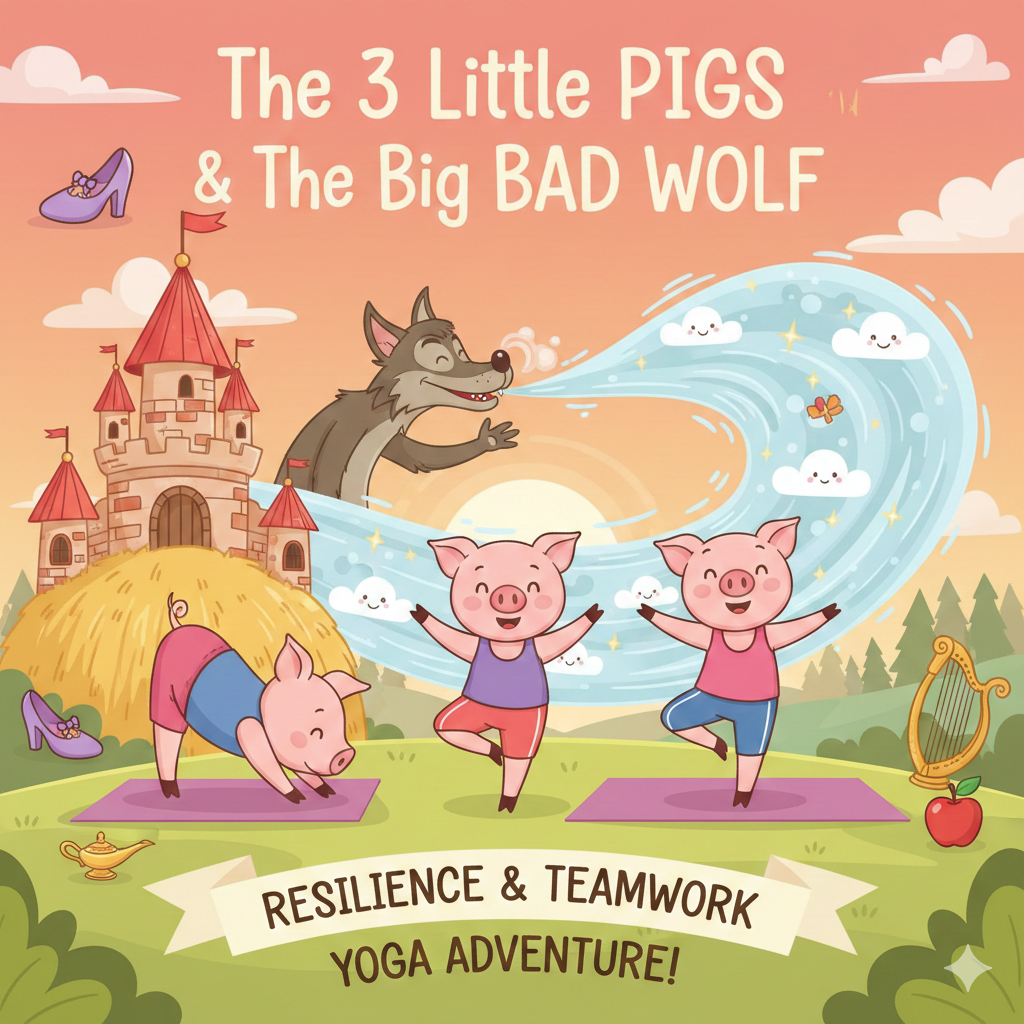
Beyond the Mat: The Hidden Science of Play
Why Our Fairy Tale Yoga is More Than Just “Storytime”
As parents, we see our children stretching, balancing, and laughing. But if we look a little closer—beyond the mat—there is a profound layer of personal growth and cognitive development unfolding.
In our current series, we aren't just “doing” yoga; we are building the internal architecture for a resilient life. Here is how your child is growing this term:
1. Navigating Challenges (Perseverance)
By weaving specific learning objectives into our fairy tale narratives—like the 3 Little Pigs' determination to build a sturdy home—we make abstract concepts like perseverance tangible.
-
The Benefit: Children learn that physical challenges (like a house blown down) is a metaphor for life's hurdles (a project that is proving difficult). they learn to try again, and not be defeated at first drafts.
2. The Architecture of the Brain (Executive Function)
Yoga is a workout for the “command center” of the brain. When we ask children to remember a sequence of poses (using repetition, with poses and breath assigned to each character in the story like Piggy number 1 , 2 or 3), we are strengthening their executive function.
-
The Benefit: This improves memory, focus, and the ability to follow multi-step instructions—skills that translate directly to the classroom.
3. Finding the “Quiet Button” (Emotional Regulation)
We link our movements to emotional regulation. Our “Wolf Breath” isn't just a silly sound; it’s a tool to down-regulate the nervous system, which will be practiced again and discussed aside the stories with variations that can be helpful at school or at home.
-
The Benefit: By practicing “stillness” on the mat, children are learning how to hit their own internal pause button when they feel overwhelmed or frustrated at home or school.
4. Building Independence (Motor Coordination)
As the weeks progress, we encourage independence in sequencing. We move from “follow the teacher” to “leading your own Sun Salutation sequence?”
-
The Benefit: This builds incredible confidence. Watching a child independently move through a sequence of poses shows they have mastered both their motor coordination and their self-trust.
The “Yogamoo” Difference: > We don't just hope these outcomes happen; we look for them. We evaluate every session by observing shifts in behaviour, the length of a child’s stillness, and their growing independence. We are committed to nurturing the “whole child,” one breath at a time.


Leave A Comment